Category: Infectious Diseases Emergencies
Deadly Ebola Virus Ravaging Africa
Severe Pandemic in West Africa
A deadly pandemic has been brewing in western Africa since December 2013. This latest outbreak of the deadly Ebola Virus Disease (EVD) began in the Republic of Guinea and then spread to Sierra Leone and Liberia. To date, 344 suspected and confirmed cases of EVD have been reported in Guinea, 112 in Sierra Leone, and 13 in Libera. Since emerging in 1976 in Sudan and Congo, EVD outbreaks have occurred 33 times.
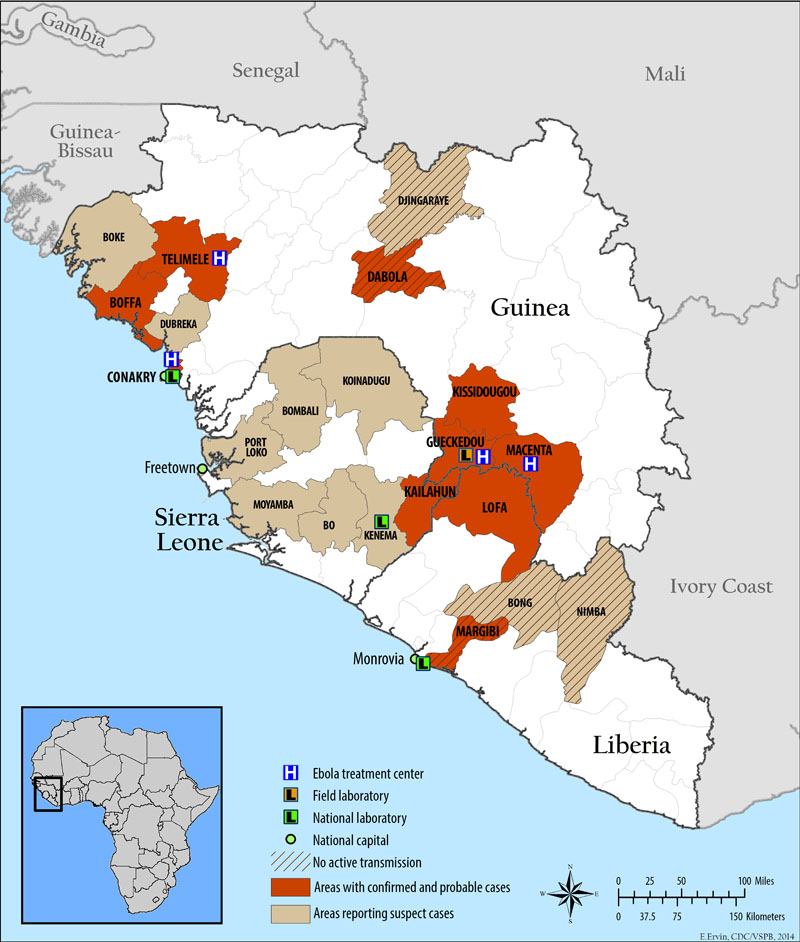
Courtesy of the CDC
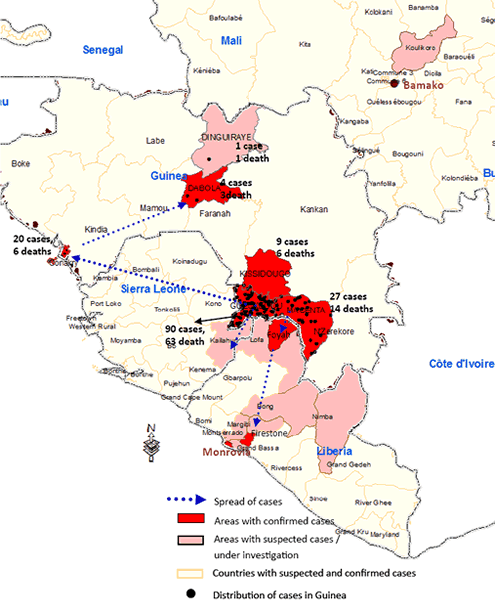
Spread of Ebola, Courtesy of Relief Web International
Measles: Highly Contagious Disease Reaches New Epidemic Levels
Measles is Back and it’s Entirely Our Fault
If you haven’t heard by now, the measles virus is on the rise in the United States. As of May 23, 2014, 288 cases have been reported in 18 states with 15 distinct outbreaks making up 79% of the reported cases this year.
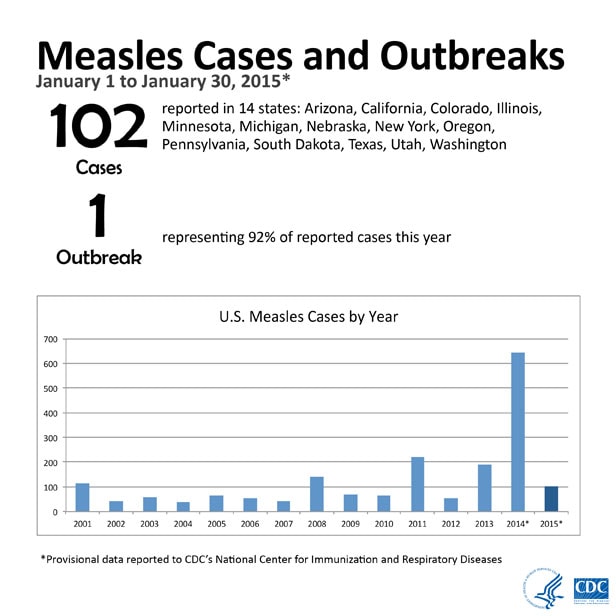
CDC Measles Cases and Outbreaks 2014
Global Vaccine Programs: Health Security not National Security
White House Responds to Plea from Public Health Schools
In January 2013, deans from 13 schools of public health sent a letter to the White House declaring that it was dangerous and unethical to use public health workers for military intelligence gathering of any kind. This concern was prompted by the discovery that the Central Intelligence Agency (CIA) used a sham vaccination campaign against Hepatitis B in 2011 to gather DNA samples in Pakistan for the purpose of finding Osama bin Laden’s hiding compound.
After the fictitious campaign was discovered, the fragile trust that public health workers had managed to build, particularly those providing vaccines, was completely shattered in Pakistan and elsewhere. The Taliban banned health workers, villagers kept them away from their children, and some volunteers were even killed out of fear that they were spies or were attempting to sterilize young girls.
Syndromic Surveillance: Is Big Brother Looking Out for You?
On May 15, 2014, The New York Times reported about a program implemented in New Orleans which mined patient personal health information to identify which parents to warn prior to an impending ice storm. Dialysis patients were advised to get their treatments early, and those on ventilators were called so they knew how to get help if the power went out. New Orleans city officials knew whom to contact based on submitted Medicare claim requests. This data is now available for public emergency response and preparedness through the Federal Privacy Act of 1974.
Middle East Respiratory Syndrome (MERS): Global Travel Raises Concerns for Spread of Disease from the Arabian Peninsula
Middle East Respiratory Syndrome-Coronavirus (MERS-CoV), a novel Coronavirus in the same family as the Coronavirus that caused Severe Acute Respiratory Syndrome (SARS), has caused 339 illnesses and 102 deaths in Saudi Arabia . However, the WHO has only reported 262 laboratory-confirmed cases. Six Middle Eastern countries have reported MERS (Saudi Arabia, Qatar, United Arab Emirates, Jordan, Oman, Kuwait) and 5 other countries have reported traveler-associated MERS cases (United Kingdom, France, Tunisia, Italy, Malaysia). On May 2nd, the United States became the 6th county to report a traveler-associated MERS case. According to the CDC, an American healthcare worker flew back to the US from Saudi Arabia on April 24th, connecting in London and Chicago before taking a bus to Indiana. He is currently hospitalized and in stable condition. US Public Health officials are tracing the US MERS patient’s travel itinerary and attempting to contact other travelers who may have been in close contact with the affected individual. Currently, the US government has not issued any warnings to travelers to avoid the affected countries or to change travel plans.

